Why the licensing provisions of The Civic Government (Scotland) Act 1982 (Licensing of Short-term Lets) Order 2021 (the ‘Order”) will seriously damage the Scottish Tourist Industry, and local economies, through closure of self-catering businesses.
1 OVERVIEW
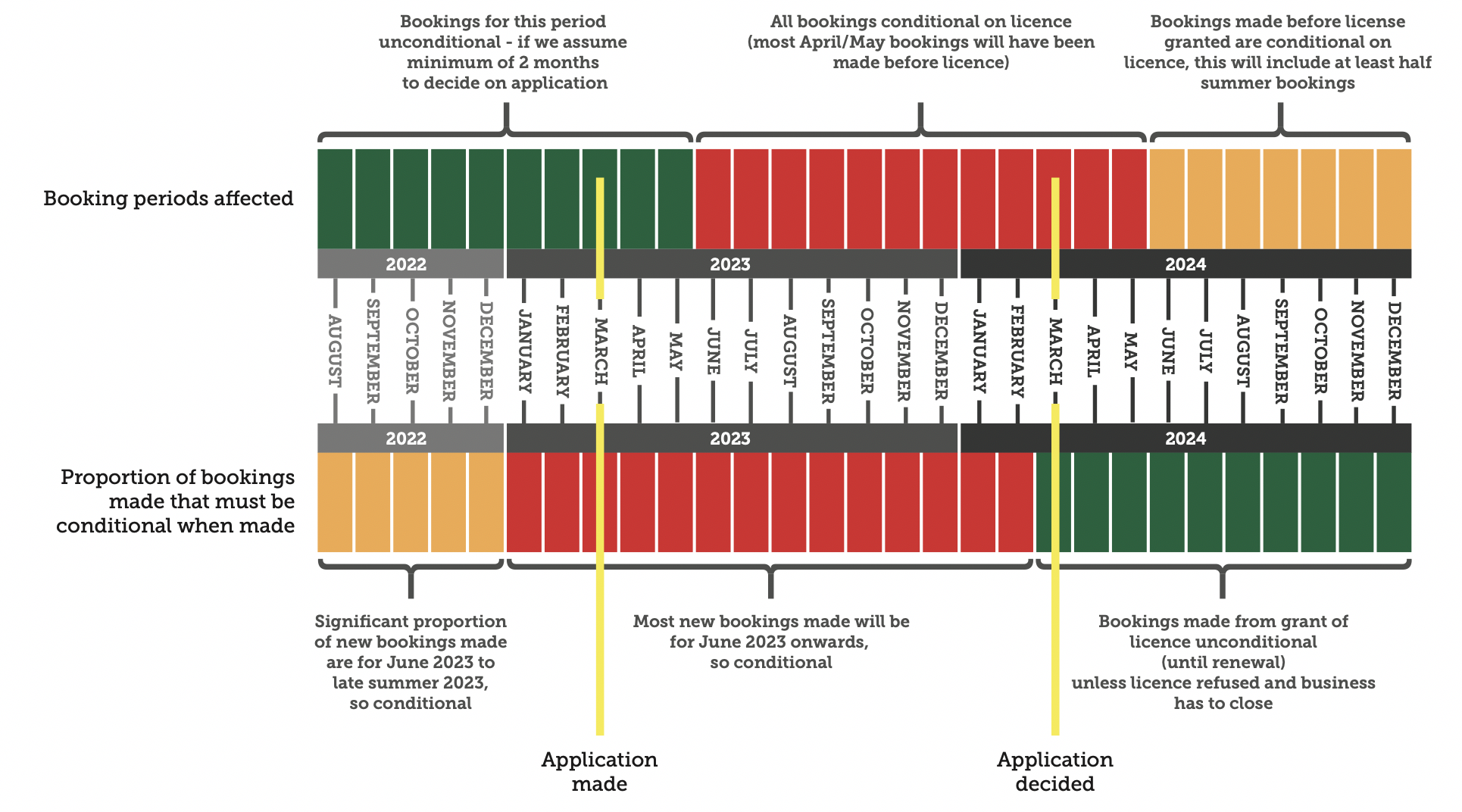
Councils have 12 months to grant or a refuse an initial licence, and 6 months for a licence renewal. Given the resource implications and other pressures on Councils, holiday let operators will assume that Council’s will need most of that time. For busy times, many guests book up to 12 months in advance. So there will be significant extended periods (shown visually in a diagram below) when operators will not be able to guarantee the booked property will be available. Bookings will have to be conditional as there is a very real risk that a licence might be refused.
But the commercial reality is that guests will simply not book if their bookings are conditional and subject to a term between owner and guest that says the owner can cancel the booking if they cannot either obtain or renew a licence. Why would they? Many will simply vote with their feet: booking accommodation in the North of England where no such conditions will apply.
The Scottish Government don’t seem to think this is a problem: Kevin Stewart MSP, Minster for Local Government, Housing and Planning, outlined in a letter of 11 Dec 2020 letter to Willie Rennie MSP: “With regard to the handling of bookings, please see paragraph 7.15 of the consultation report. We would expect the position in respect of refunds etc. for future bookings affected by refusal, suspension or revocation of a licence to be covered by booking terms and conditions in the same way as any other scenario in which the accommodation becomes unexpectedly unavailable, such as through fire damage or flood”.
This is equivalent to a supermarket saying to a customer: “you can put all your shopping in the basket, but we might decide we are not going to be able to sell it to you when you reach the check-out”.
This shows a complete lack of practical understanding of commercial contracts in the tourism sector and will be one of the key reasons why many owners will simply close.
2 INTRODUCTION
In a response to an October 2020 survey of property owners by the Association of Scotland’s Self-Caterers (ASSC), of the 1184 respondents nearly half (49%) would leave the self-catering sector if the proposed licensing scheme was introduced and of those 33% would leave the property empty or use it for family & friends[1].
The self-catering industry is the backbone of the Scottish Tourism Industry. It goes without saying how damaging business closures will be to tourism in Scotland, its supply chain and the local businesses that only tourism makes viable. And this, at a time when the Scottish Government should be encouraging staycations both to help with post-Covid economic recovery and to help minimise climate change.
There are many reasons, particularly in the context of small single property businesses which the majority are, why businesses will close: concerns with the bureaucracy involved in applying, licence conditions which may be impractical or unworkable and unknown, open ended application costs, uncertainty over recouping investment in the property (repairs, new boilers etc).
This note explains a further and very specific key concern that will further fuel business closures: the damage and uncertainty around future bookings that the licensing procedure itself creates.
3 BASIC LICENSING REQUIREMENTS (ARTICLES 3,4 & 5)
Under article 3 of the Order as read with article 4 “short-term lets” (defined in article 2(2)) after 1 April 2022 require a licence under Part 1 of the Civic Government (Scotland) Act 1982, as amended by Schedule 2 of the Order (and also the further amendments in article 6 where the transitional provisions apply).
A licence is to be subject to the conditions in schedule 3 to the Order and to other conditions the Council may impose.
Period of licence
This is provided for by Par 8 of Sch 1 to the 1982 Act as amended by Para 7 of Sch 1 to the Order. This gives complete flexibility to the Council to decide the period before renewal is required –
- 3 years (the default)
- “such SHORTER period as the licensing authority may decide” (NOT disapplied by the Order)
- “such longer period as the licensing authority may decide” (introduced by the Order)
4 TRANSITIONAL PROVISION FOR EXISTING OPERATORS (ARTICLE 6)
Article 6 provides that a person who provides a short-term let without a licence after I April 2022 does NOT commit an offence if –
- they carried on the business before 1 April 2022, and
- they apply for a licence before 1 April 2023, and
- the licence application has not been determined (this includes determination an appeal made to a sheriff within 28 days of a licence refusal – see para 18(4) of sch 1 to the 1982 Act)
Article 6(2) requires the Council to reach a final decision with 12 months of the application. This does not appear to apply to licence renewal: so assumption is that 6 month limit applies for renewals.
5 THE PROBLEM
When an owner applies for a licence (or a renewal) they will not know –
- if it will be granted or refused
- how long the application will take
Refusal is a real not theoretical risk – explored below.
So that means that for a significant period before, and after, the date of the licence application either –
- Future bookings will need to be conditional on a licence being obtained, failing which the owner can cancel without penalty
- Owners will have to take the risk of cancellation
Owners taking the risk would be quite unacceptable: it would be dishonest, it would lead to potential legal claims for breach of contract and would do serious reputational damage to the Scottish tourist industry.
That leaves making bookings conditional on a licence being granted. This is the solution suggested by the Scottish Government –
“With regard to the handling of bookings, please see paragraph 7.15 of the consultation report. We would expect the position in respect of refunds etc. for future bookings affected by refusal, suspension or revocation of a licence to be covered by booking terms and conditions in the same way as any other scenario in which the accommodation becomes unexpectedly unavailable, such as through fire damage or flood.” Kevin Stewart MSP, Minster for Local Government, Housing and Planning. 11 Dec 2020 letter to Willie Rennie MSP
This is contractually perfectly possible but commercially totally impractical and unfortunately betrays the lack of practical understanding by the team working on the Order of the way in which the self-catering industry operates in the real world. Fire damage and flood are statistically very unlikely and are risks potential guest are well aware of. Why would anyone book a holiday at a key time of year that the owner can cancel without penalty, leaving them potentially too late to find an alternative, if they don’t get a licence? How can potential guest be in a position to take view on untested risk that the business owner can’t even quantify? Much easier surely to cross the border in nearby Northumberland and the Lake District where no such conditions apply.
Worked Example

[2]
If an initial licence application is made in March 2023 (the prudent time to apply given that licence granting is not automatic and owners will wish to minimise their losses by running their, Covid damaged, businesses as long as they can), this period of uncertainty could last until March 2024. The reality is many guests book up to 12 months in advance, especially for the summer, Christmas and Easter. That means that bookings would for post 1 April 2023 bookings would start from summer 2022, and would all have to be legally conditional on a licence being granted. This uncertainty could continue until March 2024 by which time many bookings would normally be made for summer 2024 and even Christmas/New Year 2024/5. So, for a period of up to, potentially, 20 months from summer 2022 the owner would be have to make some bookings (those made before March 2023 but for post 1 April stays), then eventually all bookings (post 1 April) conditional on a licence being granted. Unless (highly unlikely) the licence is granted within a couple of months this would have implications for not just for one summer season but for 2 summer seasons (2023 and 2024) and potentially the next Christmas/New Year.
This is not a once and for all problem. Licences will be for a fixed period and then have to be renewed (see above), albeit the maximum period of uncertainty is reduced by 6 months as the local authority will have to decide within 6 months of the application submission date, not 12 months as in the case of the initial application.
6 RISK OF REFUSAL
This is a very real risk, as there are many reasons a licence could be refused:
- Breach of planning control (1982 Act amended by Para 5 of Sch 2 of the Order)
- Applicant would not be able to “secure compliance” with conditions (1982 Act amended by Para 6(b) of Sch 2 of the Order). That includes standard conditions the local authority may choose to apply to licences
- The Council “considers” there will be a resulting over provision of short-term lets (1982 Act amended by Para 6(c) of Sch 2 of the Order) –
3A) A licensing authority may refuse an application for a licence for secondary letting if it considers that there is (or, as a result of granting the licence, would be) overprovision of short-term lets, or a specific type of short-term let of the same type as that to which the application relates, in the locality in which the premises is situated.
(3B) It is for the licensing authority to determine the localities within its area for the purpose of sub-paragraph (3A).
(3C) In considering whether there is or would be overprovision for the purposes of sub-paragraph (3A) in any locality, the licensing authority must have regard to—
(a)the number and capacity of licensed short-term lets in the locality, and
(b)the need for housing accommodation in the locality and the extent to which short-term let accommodation is required to meet that need, and
(c)such other matters as they consider relevant.”.
It is impossible for a business owner to quantify this risk.
Additionally, a licence may be granted but with conditions attached that are unacceptable to the owner.
With thanks to ASSC Member David Nash. David is a recently retired Scottish solicitor, having split his professional career between the public and private sector, in a particular as a Scottish Office legal adviser and as a partner in Shepherd & Wedderburn and as a consultant with Pinsent Masons and DWF. Until a few years ago he was also a panel member of the Scottish Parliament’s Non-Executive Bills Unit.
[1] https://www.assc.co.uk/wp-content/uploads/2021/01/ASSC-licensing-survey.pdf
[2] This diagram, which assumes a licence application is made in March 2023 and takes up to 12 months to grant or refuse, shows the effect on bookings.