STL Legislation…….. Scottish Government Committed to Getting it Right.

“The Scottish Government is committed to getting the regulation right. Although the consultation is now closed, we will, of course, continue listening but we need to focus on work to finalise the statutory instruments. It would be premature to comment on the final shape of the legislation while we are still considering all the stakeholder comments from events and responses.

We are committed to monitoring and evaluating the impact of the legislation to ensure that it is effective and targeted. We can take action in the next Parliament if this is not the case.”

Response-202000102987

“The Scottish Government is committed to getting the regulation right. Neither Scottish Government nor local authorities want to unduly curtail the many benefits of short-term lets to hosts, visitors and the Scottish economy. We are committed to monitoring and evaluating the impact of our proposals to ensure that they are effective and targeted. We can take action in the next Parliament if this is not the case.”

Response-202000100368

Accommodating Workers from Multiple Households

The ASSC has received the following guidance from the Scottish Government regarding accommodating workers from multiple households. This is very welcome news.

“We’ve carefully considered the requirements of certain sectors of the economy such as forestry, construction and digital connectivity which are reliant on shared self-catering accommodation for work purposes.  While the recommended position is for individual, self-contained accommodation for each employee, given the risks of transmission within shared accommodation, it is recognised that this is not always feasible.  Therefore, the exemption whereby workers share accommodation should only be applied where the following conditions apply:

  • Circumstances necessitate individuals to stay in shared self-catering accommodation for work purposes is defined as work which requires a physical presence in a location away from home (where the distance is such that it is not feasible to commute) and the work itself cannot be done on a virtual basis and should only be for the length of time required for work to take place and separate accommodation is unavailable or impractical.
  • Where assurance has been provided that accommodation providers and workers will comply with physical distancing and public health guidance to mitigate risk (set out below).

Special consideration should also be given to situations where a worker may be vulnerable and / or unwilling to share accommodation due to risk of Covid-19 transmission and efforts made to find suitable alternative accommodation which meets their needs.

When separate accommodation units cannot be provided and where workers are willing to share, the following guidance and mitigations should be followed:

  • Households should be limited in size to ensure that workers can access kitchens, cleaning and washing facilities and other shared spaces while maintaining physical distancing guidelines.
  • Employers and accommodation providers should conduct individual risk assessments, to ensure that there is sufficient capacity within a shared accommodation unit to ensure that users have separate bedrooms and the ability to occupy shared areas such as kitchens and toilets on their own and then clean them afterwards.  Individual risk assessment should ensure that these are of such a number that each user will have the time to occupy and use these spaces on their own and then clean them afterwards, given that at high demand times such as mornings, evenings and mealtimes such facilities will be in particular demand.
  • Workers sharing self-catering accommodation should have their own bedrooms and should adhere to physical distancing.
  • Shared bathrooms and kitchens present one of the biggest risks for increased spread of the virus.  Workers should be given the appropriate resources and instruction on how to keep shared areas clean and ventilated.
  • Residents should also be advised to use shared rooms one at a time with cleaning and ventilation in between (e.g. preparing and eating a meal).
  • Where communal toilets are available outside of households and could be used more widely, providers should implement measures to decrease this risk as far as possible in line with guidance on the reopening or public and customer toilets
  • This should include increased cleaning and may include reducing access to a one in, one out basis.  Cleaning materials should be provided for users to ‘clean as they go’.

The wording may be slightly refined within the guidance that will be published later today and we will update as required.

Industry Letter to Government: Tourism Sector Urges Regulations Rethink

Leaders from across Scotland’s tourism industry have called on the Scottish Government to delay its plans for regulations that threaten to cripple short-term letting.

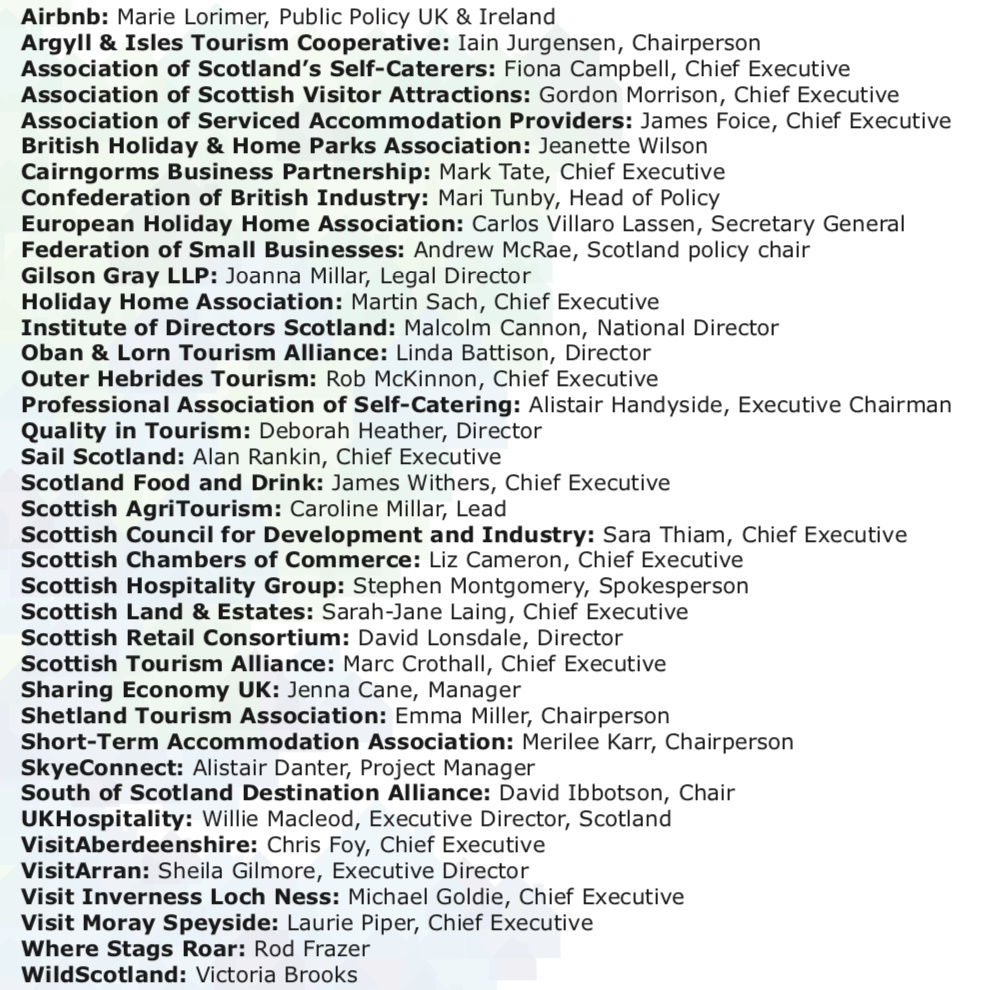
The group of 38 prominent figures from across the industry has written to Minister for Local Government, Housing, and Planning, Kevin Stewart, and his ministerial colleagues, warning him that licensing poses a significant threat to the £723million sector at a crucial time.

Signatories include the ASSC, UKHospitality, Scotland Food and Drink, Airbnb, the Federation of Small Business, the Confederation of British Industry, and the Scottish Chamber of Commerce.

The letter argues that the changed circumstances since the hastily cobbled-together ideas were first proposed mean that they are even less fit for purpose than previously thought.

Self-catering, a key component of Scotland’s tourism offering, has played a vital role in the country’s fight against COVID-19.

ASSC members shut down their properties early and worked to develop strict, government-backed, cleaning protocols in order to reopen safely and get Scottish tourism moving again.

The proposed licensing scheme, and other regulations, has sent a chill through the industry, causing self-catering operators to consider their futures and think about them much more negatively.

The ASSC, which represents the self-catering industry in Scotland, has worked closely with the Scottish Government for some time and is now calling on ministers to listen to its expert advice and that of the other organisations signing the letter.

Furthermore, all signatories to the letter have expressed a sincere interest in working productively with the Scottish Government in the future to ensure that the tourism sector works for everyone who depends on it.

ASSC Chief Executive, Fiona Campbell, said:

“The regulations that self-catering is facing may well inflict the kind of damage on our vital sector, key to creating the memory-making holidays Scotland is famous for, from which it will never recover.

“That is why our friends, peers, and colleagues from across Scottish tourism have joined with us to send this clear, unambiguous, and direct message to Mr Stewart and his ministerial colleagues – rethink this or you’ll hurt us irreversibly.

“COVID-19 has done a lot of damage to Scotland’s economy, the last thing we need is to compound it with this poorly thought out, ham-fisted, and counterproductive act of sabotage”

Letter to Kevin Stewart MSP 26 October 2020