First Minister’s Statement 22nd June 2021

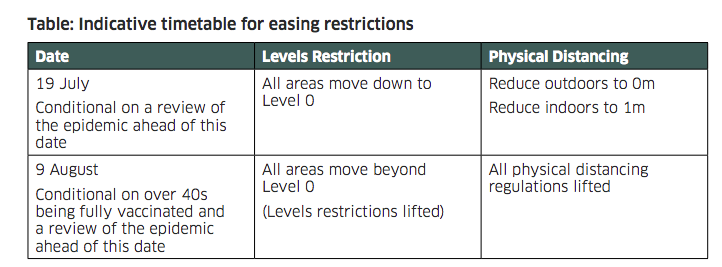
Today the First Minister gave a statement to Parliament outlining the next steps in the COVID-19 response and confirmed there would be no changes to restrictions next week, with the current expectation that all parts of Scotland will remain at current levels until 19 July.

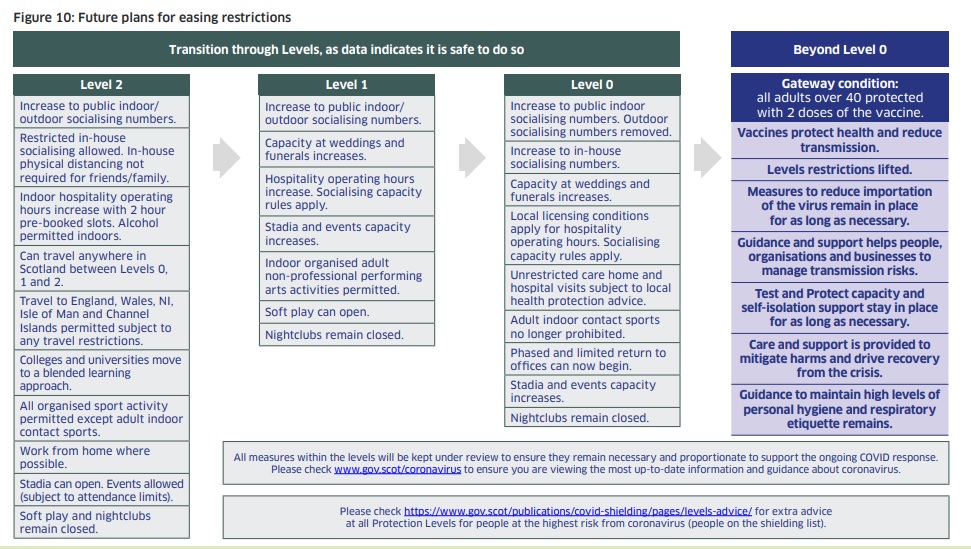
By that date, it will be more than three weeks since the completion of the vaccination programme for over 50s and it is hoped that all parts of Scotland which are not currently in level 0 will move to level 0.

By 26 July, it is expected vaccination of all over 40s will be completed, giving them a significant level of protection by 9 August. It is expected that it will then be proportionate to lift the major remaining Covid restrictions in Scotland.

However, the First Minister cautioned the easing or lifting of restrictions was dependent on meeting the necessary conditions on vaccination and harm reduction. She also said it is likely some travel restrictions would remain in place and it is also expected that a return to office working will be on a phased approach likely beginning on 19 July, with home working continuing to be encouraged.

An updated Strategic Framework has been published which highlights the Scottish Government’s strategic intention in handling the pandemic has changed from “suppress the virus to the lowest possible level and keep it there” to “suppress the virus to a level consistent with alleviating its harms while we recover and rebuild for a better future”.

The outcome of the review of physical distancing was published today, which recognises that it will be appropriate to reduce physical distancing requirements as more people gain protection through vaccination. In addition there will be some changes to rules relating to weddings and funerals from Monday (28 June).

Association of Scotland’s Self-Caterers Chief Executive, Fiona Campbell, said:

“Scotland’s self-caterers, along with our colleagues across tourism and hospitality, welcome much of today’s statement from the First Minister, specifically the additional clarity she has given on the expected dates for the lifting of restrictions.

“However, we are acutely aware that level zero does not mean no restrictions and therefore larger self-catering properties will continue to face strict curbs on their activity until August, meaning that they will require urgent financial support from the Scottish Government.

“There is also the crucial point that the date of 9 August for moving beyond level zero means that our members, especially those operating larger properties, will only have only one week of the Scottish school holidays in which to do business and will have effectively lost the entire summer season.

“It should be stressed that we are not talking about people with second homes, this is about people who rely on their businesses for their livelihoods and therefore continue to need financial support to remain viable.”

Short-Term Lets Working Group Update

The Cabinet Secretary for Social Justice, Housing and Local Government has written to the Local Government, Housing and Planning Committee today to advise members that the Scottish Government will be publishing the Licensing Order in draft later in June, for consultation, ahead of laying the Order at the Scottish Parliament in September.

Below is a copy of the Cabinet Secretary’s letter, which sets out the reasons for taking this revised approach. The Scottish Government will also be publishing the guidance in draft format later this month.

Short Term Lets – Stakeholder Engagement – Committee – Letter on Progress – 21 June 2021

The Herald (22/06/21):

SCOTLAND’S industry body for self-catering accommodation has drawn up plans for a registration scheme to allow businesses to opt out of the SNP’s plans to require Airbnb-style short-term lets to obtain a licence.

The SNP has confirmed it will hold another round of consultation to “make any other adjustments needed” to the plans before the finalised proposals are set out in September.

The Association of Scotland’s Self-Caterers (ASSC) has put forward the registration plans, which the organisation says is “balanced and proportionate” – amid fears half of traders could be at risk of closure if licensing plans are pushed forward.

The registration scheme would be managed by VisitScotland, which the ASSC say mirrors set-ups across Europe – where registration systems are overseen by tourism bodies.

But the Scottish Government has insisted that the registration scheme plans would not adequately protect guests and local communities and will therefore press ahead with licensing proposals. ​

The Scottish Government drew up plans for the owners of short-term lets and thousands of B&Bs to require a licence from their local council in order to operate after fears that too many properties were being taken out of the housing market – as well as problems with anti-social behaviour.

Health and safety standards are also key to the proposals.

But the plans were withdrawn after MSPs raised concerns over B&Bs unintentionally being swept up in the new laws.

READ MORE: SNP withdraws Airbnb-style short-term let regulation plans

The SNP’s Housing Secretary, Shona Robison, has now announced a “final round of consultation” will be held ahead of the final order being laid in September.

In a letter to Holyrood’s Local Government, Housing and Planning Committee, Ms Robison announced that councils will now have until October 2022 to “establish a licensing scheme”, instead of the original April 2022 date – but stressed “the final deadline of April 1, 2024 for all short-term lets to be licensed” is unchanged.

Ms Robison added that ministers “do not consider it necessary” to push back the April 2023 deadline for existing short-term let hosts and operators must have applied for a licence by.

During talks with officials, Fiona Campbell, the chief executive of the ASSC, put forward her proposals – which she said has “an unprecedented level of cross-industry support”.

If approved, traders signed up to the registration scheme would essentially be exempt from the Scottish Government’s licensing plans.

Under the proposals, businesses that fail to register for the scheme or are unable to comply with conditions including health and safety standards, would no longer be exempt from obtaining a licence and could face hefty penalties.

Despite the licensing regime plans being paused before the election, a proposal to allow councils to set up control zones was approved.

The ASSC has claimed the registration scheme would give local authorities robust data to justify such a measure and “could support the evidence for the future introduction of a tourism tax”.

READ MORE: Airbnb regulation ‘will put thousands of rural jobs at risk’

Ms Campbell said: “Our proposed solution for a mandatory registration scheme, backed by a range of business and tourism stakeholders, meets the policy objectives of the Scottish Government in a proportionate manner and will not unduly burden operators when we need our tourism economy to rebound after this devastating pandemic.

“Short-term let licensing is the last thing our industry needs at the current time.“

She added: “Our survey work has already shown that nearly half of self-catering operators would leave the sector if this came to pass and this will further compound the difficulties facing Scottish tourism when we should be supporting business for a sustainable recovery.

READ MORE: SNP minister: Short-term lets plans could penalise rural businesses

“Through learning lessons from the last parliamentary session when the licensing order was withdrawn, as well as assessing best practice elsewhere, the Scottish Government needs to introduce cost-effective and evidence-based short-term let regulations in partnership with industry – and that is precisely what our proposals do.”

But ministers have confirmed their commitment to the licensing regime and thrown cold water over the registration plans.

A Scottish Government spokesperson said: “Our licensing system will ensure a set of mandatory standards for all short-term lets which will help to protect the safety of guests, neighbours and local communities. A registration scheme does not offer that protection.

“Many hosts and operators will already be following these standards as a matter of compliance with existing law or best practice.”

ICO (Information Commissioners Office) REGISTRATION UPDATE

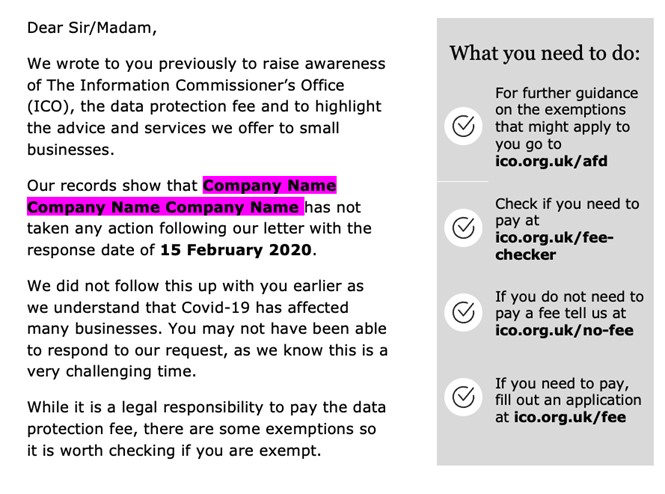
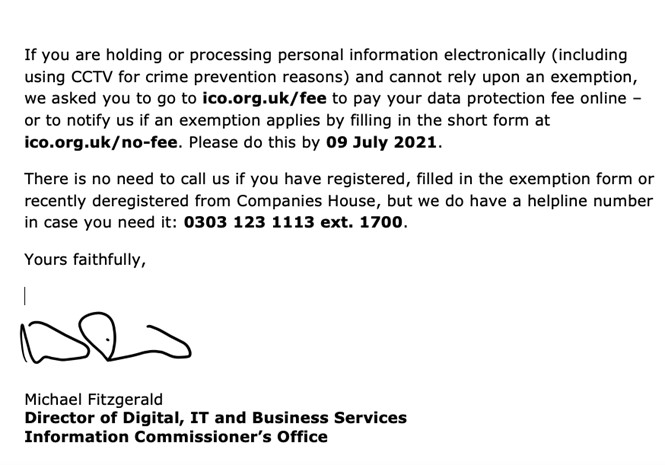
We were contacted by the ICO this week, to let us know that they are now actively chasing up on previous letters to businesses in the accommodation and food sector.
This is the letter they are sending out, and the tone has changed. You now have to either Register and pay or fill in the exemption form.


Links for the ICO Website:

ico.org.uk/afd

ico.org.uk/fee-checker

This is what they asked us to send to you…..

The Information Commissioner’s Office (ICO) is the UK regulator for data protection and information rights. In June 2021 they will be writing to the accommodation and food sector to remind you that you may have a legal responsibility to register with the ICO and pay the data protection fee. For most companies, this is £40 or £60 per year.

If you receive a letter, you should check if you need to pay and, if you believe you are exempt, you should let the ICO know by 9 July 2021. If you are not exempt, you will need to register through their website and pay the fee. Please note, if you use CCTV for crime prevention purposes it is likely that you will need to register.

There is more information for the activities of households sector on the ICO’s website: Paying a data protection fee – accommodation and food sector: https://ico.org.uk/afd

They also have a web hub specifically designed for small and medium enterprises which has lots of tips and simple guides that you will find useful: SME web hub – advice for all small organisations | ICO: https://ico.org.uk/for-organisations/sme-web-hub/

Thanks to PASC UK for this information:

PASC UK commissioned our solicitors Stephens Scown to write up notes on whether you need to pay, and we have added more FAQ’s to this to. These are available on the website at: https://www.pascuk.co.uk/publications