Updated Guidance 2nd December

We have, this evening, received the following clarification from the Scottish Government:

“We’re sorry to come back to you on the festive bubble question later than anticipated.  This was being considered by public health colleagues and Ministerial sign off was also sought.

Taking account of issues that you and others have raised around the festive guidance, the following changes have been agreed and will be updated in regulations (likely tomorrow)’:    

A bubble or members of a bubble can use self-catered accommodation (or a second home or caravan) providing it is in the local authority area that one of the members of the bubble lives in.  Operators are required to check that when they take the booking one of the members of the bubble lives in that local authority area.

The geographical restriction has been included to minimise any spread of the virus related to travel during the festive period.

The travel ban is in place beyond the lockdown ending in England, based on an assessment that the risk of importation of cases remains high.  This is also the position with Ireland.  This will be reviewed regularly, based on an assessment of risk (for Wales people are still not allowed to leave Wales for the purpose of a holiday).

The rules below on travel apply until the festive period.

Can my bubble stay in self-catered accommodation?

We recognise that people will not always have a house big enough to accommodate a Christmas bubble.   The law therefore lets a bubble meet in self-catered accommodation (or 2nd home) for a Christmas gathering, but only in the local authority area in which you or a member of your bubble lives.   As we need to prevent the risk of spreading the virus, a Christmas gathering is not allowed in an area outside the local authority area in which one of the participants lives.

Operators should check that at least one household participating is from within the postcode area.

A maximum of 8 people from up to 3 households which have formed a bubble can stay in self-catering accommodation over the period 23 – 27 December.  Children under the age of 12 from these households do not count towards the total number of people in the bubble. If you are staying with another household you should not have more than one household (or extended household) staying in each room booked.

Visiting Scotland from other parts of the UK and Ireland

Under current Scottish regulations, unless you have a reasonable excuse, you must not travel between Scotland and England, Wales, Northern Ireland and Ireland. Find out more from Scottish Government travel between Scotland and the rest of the UK.  Travelling for a holiday is not a reasonable excuse.

Visiting Scotland from other parts of the UK during the Christmas period

As agreed by all 4 UK governments travel between Scotland, England, Wales and Northern Ireland is permitted to allow families and friends to gather to form a Christmas bubble between 23 to 27 December (22 to 28 December for Northern Ireland).

The location of a Christmas bubble in Scotland must be in the local authority area which a member of the bubble has their main residence.  A bubble can meet in self-catered accommodation for a Christmas gathering, but only in the local authority area in which you or a member of your bubble lives.  Operators should check that at least one household participating is from within the postcode area.

The bubble should not meet or stay in hotel or B&B accommodation together during the Christmas period.  However, individual members or an individual household which is part of a bubble may use hotel or B & B accommodation nearby.

Find out more from Scottish Government guidance for the festive period.
UPDATED: Coronavirus (COVID-19): Guidance for Festive Period (issued:26/11/20)

The Scottish Government has published its guidance on restriction relaxations between 23rd and 27th December.  The guidance stipulates that Christmas bubbles (no more than three households) should be kept to a maximum of eight people (children under 12 are exempt from the rules); those bubbles are not allowed to visit restaurants, bars or tourist accommodation.

During the Christmas period those who are part of a bubble should not stay in tourist accommodation.  Only those not part of a bubble should plan on staying in tourist accommodation and should follow the tourist accommodation, socialising and travel rules in the local authority area you are staying. For example:

  • you should only stay with your own household (or extended household) in self-catering accommodation
  • you must not travel into or out of a level 3 or 4 area for tourist accommodation

Those who have formed a bubble should only socialise in a hospitality, leisure or entertainment venue in your own household (or extended household) for the duration of the festive period.

Socialising and opening hours for pubs, bars, restaurants and cafes are as per the local authority protection levels that the venue is situated in.

Christmas bubbles can only gather in a private home, outdoors or at a place of worship.

See the Scottish Government’s guidance on travel and transport .

See the UK Government’s guidance on Making a Christmas Bubble with Family and Friends. This states that “You can stay in private rented accommodation with members of your household, or your Christmas bubble”.

We are seeking urgent clarification on this updated guidance and will provide more details as soon as possible:

The Scottish Government seem to have completely changed the definition from self-catering which was previously (from 24th September) defined as a private dwelling, therefore limited to one household and not able to utilise the 6/2 rule.  Now, despite relaxation of rules for 5 days over Christmas, allowing an 8/3 people to households ratio, the definition has now changed and self-catering accommodation is no longer a private dwelling.  There must be some consistency if the regulations and Scottish Government guidance are to be taken seriously by our members, the hospitality sector and the public in general.

Response from the Scottish Government 26th November: “I’ve been in touch with a few colleagues regarding your queries about self-catering accommodation over the festive period.  I’m afraid with tomorrow being a public holiday, we won’t be able to provide a full and considered response until early next week.  This is because the festive guidance and advice on social bubbles etc. has been guided by clinical and public health advisers and we will need their expert input and feedback. I know that you were (understandably) keen to provide an update to your members prior to the weekend and am sorry not to be able to assist within these timescales.  We’ll be following this up as a matter of urgency early next week however.”

Scottish Government Updated Guidance: Coronavirus (COVID-19): Guidance for Festive Period (issued:26/11/20)


Scapegoating Short-Term Rentals Won’t Solve the Housing Crisis

There’s a housing crisis in this country. Scotland, and our capital city in particular, just doesn’t have houses available to meet the needs of our population. This lack of housing represents one of the biggest challenges that we face as a country and, without doubt, something must be done about it – and soon. It is simply too important a problem to be allowed to get much worse.

However, before we can begin to resolve this situation, we must understand how it came about in the first place. If our medicine is to work, and for future generations of Scots, and it must, we have to understand how the patient became ill and what their symptoms are.

Sadly, in the context of the housing crisis, this is where our politicians and pressure groups make a huge mistake as they continually misdiagnose the problem and how it came about. Driven by a variety of different individuals, from fringe politicians to respected figures in the property business, some opinion-makers have decided that there is a direct relationship between the number of short-term rentals in Scotland, especially in Edinburgh, and the housing crisis.

Whether they are spurred on by their own self-interest, politically motivated reasoning, or the need to feel relevant, their diagnosis is the same – short-term rentals have caused the housing crisis. No ifs, no buts (and nothing to do with housing cuts).

Far from being just an innocent mistake, the promotion of this falsehood has serious implications. For the same reason that a misdiagnosis has serious ramifications for a patient, without meaningful action, things will get worse.

The truth is that the short-term rental market, while it is worth £50million to Edinburgh and £723million to Scotland as a whole, actually accounts for a tiny percentage of housing stock, according to our recently published report, Far More Than Just Houses. In fact, according to National Reports statistics, there are five times as many empty properties in Scotland than there are self-catering properties. Short-term rentals simply aren’t there in sufficient numbers to have a significant impact on housing supply.

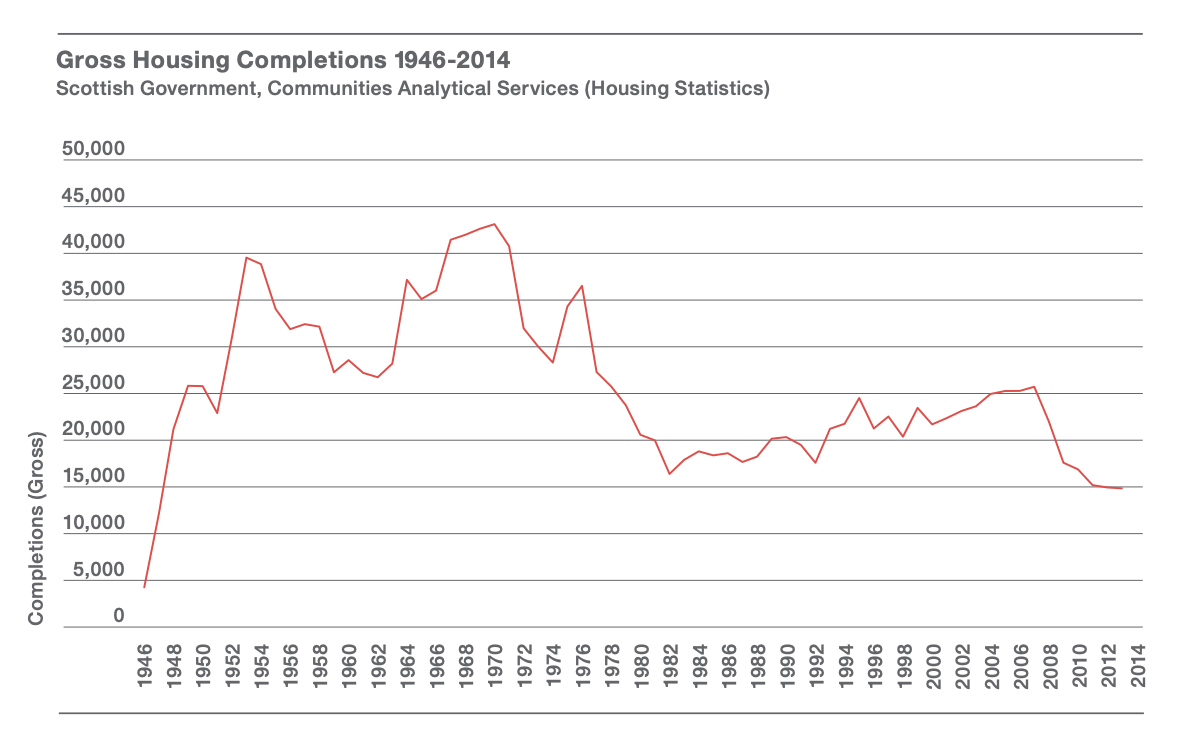
What has led to the housing crisis is the fact that not enough houses have been built.

While the crisis is not the fault of any one government or party, there is blame that must be shouldered if we are to address the problem like a grown-up country.

The governments of the 1970s through to the 1980s oversaw a massive reduction in housing construction – a trend carried on through the 1990s and the 2000s by successive administrations. This is understandable as governments face competing pressures and committing to housebuilding is a large commitment for any government to undertake; but the facts are the facts and we’ve seen a reduction in housing stock and a steady increase in population. Compared to these factors, whatever increase in short-term rentals there may have been in Scotland or anywhere else is insignificant.

The motivation is perfectly clear, even if it is not justifiable; it is far easier to make a scapegoat out of an industry than it is to look back on the past decades of housing policy and conclude that monumental, era-defining, mistakes have been made in planning and execution. To blame short-term rentals is easy, simple, and can be morphed into a moral crusade for people to get irate and indignant about. A good, hard, honest look at housing policy is difficult.

We at the Association of Scotland’s Self-Caterers, Scotland’s only trade body representing the traditional short-term rental sector, have an interest in being represented accurately and for all the issues that effect our sector to be handled sensibly and with vision. The scapegoating in the name of finding an easy answer that we’ve encountered is as far removed from this as could be.

Rather than taking cheap-shots at the people who make their livelihoods and support their families in our historic industry, which is as important a part of our compelling and world-beating Scottish tourism offering as any other, policymakers and influencers would be better placed using their sway to get on with the job of building more houses for those who need them. Committing to this would be a bold and difficult decision to make but, as the old adage says, nothing worth having ever came easy.

The number of Scots who are facing housing insecurity is too high. Now is the time for action on housing stock and to stop blaming a sector whose impact on that supply is negligible. Scots deserve better and any politician who took the initiative and worked to help them would have the support of the ASSC and all of our members across Scotland.

Fiona Campbell
Chief Executive, Association of Scotland’s Self-Caterers